
Foundational Research Immersive Systems
Problem Statement
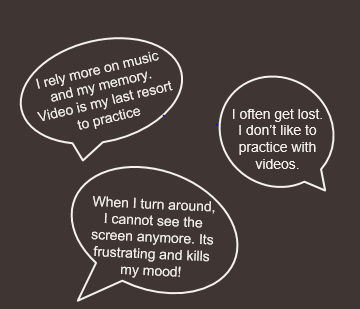
Isadora Duncan is also known as Mother of Modern dance, and her dance form is now going obsolete. So far, her legacy has been carried forward primarily through oral transmission to the next generations. Since dancers are kinesthetic learners, simple videos and texts are not accessible for them to learn and practice. In this era of new media,
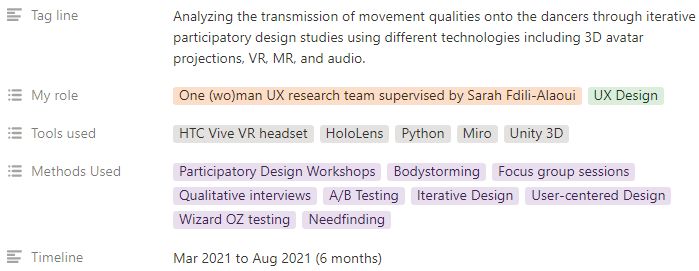
How can we design interactive technologies to transmit Isadora Duncan's dance movement qualities on to the dancers?
Solution
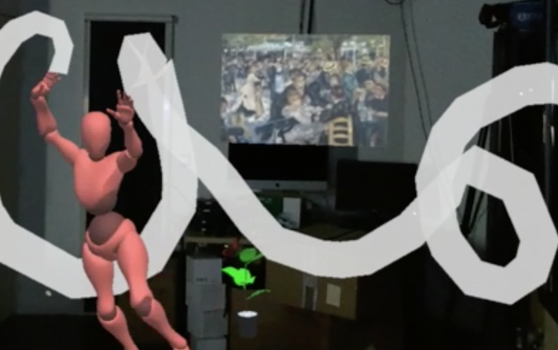
I designed a Mixed Reality experience with visualizations including digital avatars, tracing lines, story experiences, 3D models, paintings, texture, colors etc to inspire dancers' emotions and creativity. We(my supervisor & I) conducted 4 participatory iterative research workshops and followed somaesthetic design to arrive at this solution.
In the below sections, I have described my process, collaboration with an engineer and a PhD student in developing the experiences, and the challenges I faced while dealing with the engineering complexities vs the need for creative expansion in users.
Breaking down the research questions
💡 1.a. What are Duncan’s dancers’ motivations (intentions, desires) and bodily experiences while moving (performing actions)?
1.b. How can Duncan’s movement principles be expressed or transmitted to users through aesthetic experiences?
💡 2.a. To probe and understand the dancers’ relationship with the technology they use and their environment.
2.b. Also, probe on how technologies constraints/supports their movements.
💡 3.a. To uncover users’ mental model (images, colors and textures) while practicing Duncan’s dance.
3.b. How to leverage it to create an engaging somaesthetic experience for the users?
Research Plan
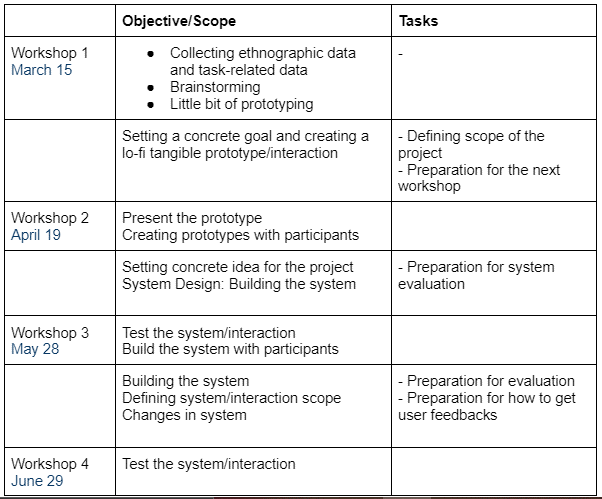
I initialized contact with my stakeholders to finalize the broad plan for the research workshops. The following objectives were to be achieved:
- Discovery: Need finding through experiments with different technologies to investigate how technologies can support and constrain the transmission of Duncan's movement qualities onto dancers.
- Evaluating solutions: Test all the 5 prototypes to understand what features and design elements work or don't work and the “why’s” behind them.
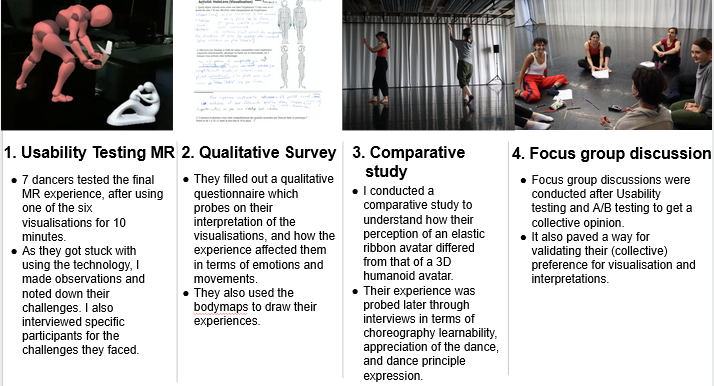
- Usability Testing: Test the final MR experience with visualizations and conduct A/B testing to compare a humanoid avatar Vs an elastic ribbon avatar in transmitting Duncan’s movement qualities.
Methodology
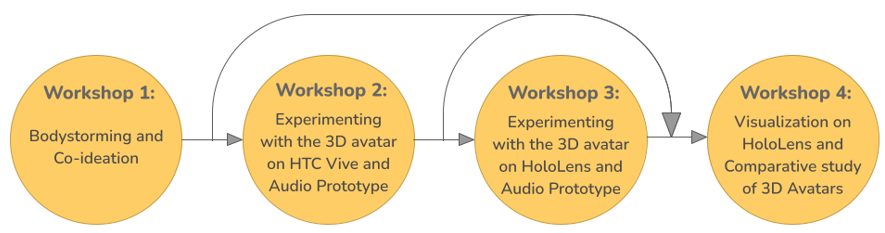
We primarily followed a participatory design approach, while implementing an iterative design methodology and following principles from user-centered design.
Choosing the right research methods
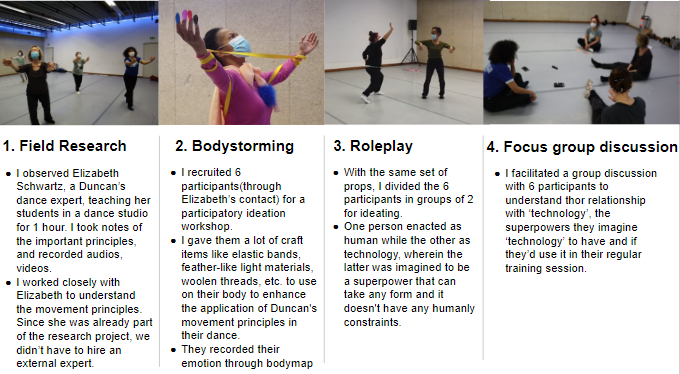
To answer our first and second research questions, we required users' qualitative and attitudinal data. So we chose a participatory design approach. Moreover, in the discovery phase, we wanted to explore different ideas to help dancers learn through technologies. For this, roleplay helped us to portray "technology" as a superpower. To create an aesthetic experience, we wanted to explore every aspect of how they use their soma(or body) -which led us to use bodystorming method. This helped us to empathize better with the users' body, since the dancers could directly 'show us' rather than 'tell us'.
Thematic Analysis
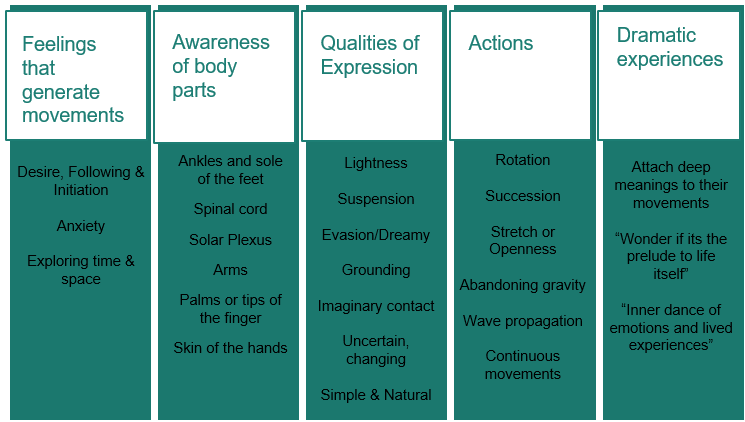
From field research, the four important principles based on Duncan's movement are :
🍀 Simple and natural - Duncan's dance movements are inspired by natural phenomena and rediscover the classical principles such as form, beauty, and motion.
🪂 Abandoning gravity - exploiting gravity to create movements that show lightness.
🌊 Wave propagation - They're like the sea waves that go back and forth, indicating the 'vibrations'.
♾️ Continuity - the movements look as if they are never-ending and continuous.
Designing and testing lo-fi prototypes
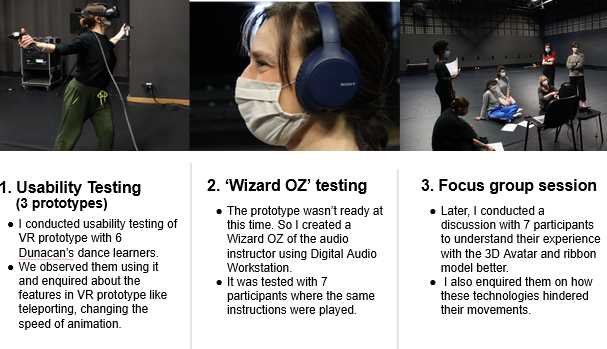
We designed three low fidelity prototypes (VR prototype with digital avatar, Wizard OZ audio prototype and on-screen digital avatar animation) and tested with users for their functionalities, usefulness and usability. Half way into the development, since the project was technologically intensive, we also collaborated with an engineer to develop experiences in XR technologies.
Key Insights
💡 VR prototype : Their first reaction was to dance with the avatar in VR experience. However, the headset constrained their head, hand movements. They found the VR experience “metaphorical” and useful. Navigating around the avatar in VR helped them “to observe Duncan's emotion and energy up-close, and give better clarity to the movements”.
💡 On-screen prototype : This system was rated poorly by the users, as they tried to dance in groups with the ribbon Avatar. It was not practical as they “could not see the screen when turned around”.
💡 Audio Prototype : This prototype pushed them to be creative and “helped them to discover Duncan's style because they were able to experience the movement outside of a set choreography". However, they did not like using headphones, and rather preferred dancing in groups with their friends.
Developing and testing hi-fi prototypes
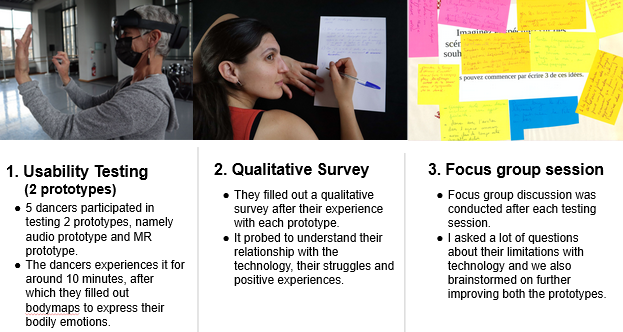
I collaborated with the engineer to develop an MR experience with the digital avatar. I also developed the audio prototype in Python (individually). These 2 prototypes were later tested in Workshop 3.
Key Insights
💡 Audio Prototype: The “togetherness” factor while dancing to the instructions attracted the users to this tech. They would like to use this everyday to train for Duncan’s movements, especially at homes.
💡 Mixed Reality prototype: They liked how it allows them to move freely without the wires, compared to Vive headset. However, “the experience was more cerebral than really corporeal” for them. **And HoloLens fell down from a participant’s head during the experiment, after which she had to restrict her neck movements. The headset wasn't particularly designed to handle the rugged head movements of a dancer.
💡 Imagination in movement learning: In the brainstorming session, participants expressed their interest for scenic virtual spaces. They would like to "play with the spaces of immersion, change of scenery, to recall the imagination put in play by this or that dance.”
Bridging the gap between Engineering and Creativity
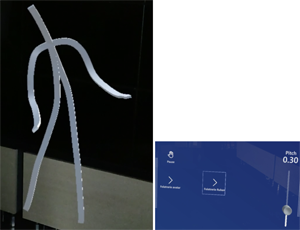
Finally, I collaborated with the engineer to develop an imaginative MR experience. Though users suggested ideas for heavily animated aesthetic 3D experiences, considering the engineering complexity and time constraints, we designed and developed an experience with tracing lines, elastic ribbon avatar, story experience, different paintings and 3D models that induces feelings in users.
Overall Insights
- In the final experience, the average rating of their understanding of movements increased to 7.8 out of 10.
- Dancers "dramatize" their experiences and the objects around them. So invoking their imagination and creativity while moving, contributed positively in the transmission of Duncanian movement qualities on to the dancers.
- Visual metaphors like virtual objects, tracing lines, avatars and story experience helped the users to emotionally connect to their moving experience.
- Dancers enjoyed experimentation and open-ended exploration with their bodies while keeping the dancing style(principles) intact. This helped them to think "outside the box".
- Technology should be carefully designed such that it does not hinder their active body parts while dancing. Since it is important for them to feel their physical body in the Duncan's dance style, it is important that the technology doesn't disembody their dancing experience.
Results and Impact
I truly appreciated graduating from Interaction Design course after such a great project with amazing colleagues around, from whom I learnt so much !
I analyzed the outcomes based on 6 themes including how technology supports transmission, how technology constraints dancer’s body, emergence of new possibilities, etc. The details can be found in my Masters Thesis. And a research publication based on this research in progress.
This also resulted in an additional research publication at the Creativity and Cognition conference for the computer graphics PhD student who developed the elastic ribbon digital avatar.
Challenges Faced and Learnings
- I could not analyse the prototypes and conduct the study in-depth because of time constraints to finish my thesis within 6 months. If I had more time, I’d try to understand the relation between each user’s visual preference to their background (eg: dance style, number of years in dancing experience, emotional quotient, etc). I’d also give more flexibility to the users in choosing and customizing their experience
- Another challenge I faced was the need for translation from English to French and vice versa. Though most of the participants understood English, sometimes they need a translator to understand the tasks better. Since I was not fluent with French, my supervisor and the dance expert helped me to translate my words during the workshop, whenever required. And to translate their data from French, I used text translators.
- I initially took this project for my interest to bring arts and technology together. This project, rather gave me the opportunity to understand my passion for understanding users’ needs. I got more confident after planning and handling the workshops single-handedly while using different UX research methods, and collaborated with different stakeholders including engineers, end-users, developers to recognize my future career interest as UX researcher.